
Proactive VPN Encryption and Protection Explained
VPN encryption is a complex process since it implements well-tested advanced mathematics procedures. Keep reading to understand how ExtremeVPN ensures your data and communications safety.
How Reliable is the Encryption of ExtremeVPN?
ExtremeVPN not only just hides your IP address from other users but also encrypts the traffic between your computer and secure VPN servers. This restricts third-party organizations from accessing your data.
Our VPN uses the AES-256 protocol – an Advanced Encryption Standard with 256-bit keys. This encryption standard is famous in the US, and many security professionals use it to protect their classified data.
256-bit keys refer to a possible combination of 1.1 x 10^77 or 2^256, which are 089,115,195,237,316,792,423,985,570,008,907,687,853,984,269,665,560,640,000,000,000,000,000,000,000,000 combinations! It means a brutal attack on 256-bit keyspace is virtually impossible, even if you can run the world’s strongest computers forever, for thousands of millions of years.
A Guide to Our High-end VPN Protocols
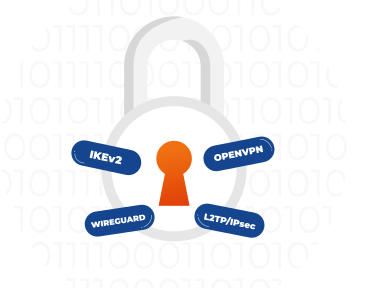
ExtremeVPN utilizes a number of VPN protocols to provide safe and secure encryption between your PC and the VPN servers. We allow users to switch between these protocols easily. However, a much better approach is to select the default setting, which automatically adjusts the most suitable protocol for your speed and security.
Besides providing some basic set of protocols, such as IKEv2 and OpenVPN, ExtremeVPN offers Wireguard which surpasses others in terms of speed, security, and reliability. It provides a more secure, more faster VPN experience.
What is VPN Tunneling and Encryption?
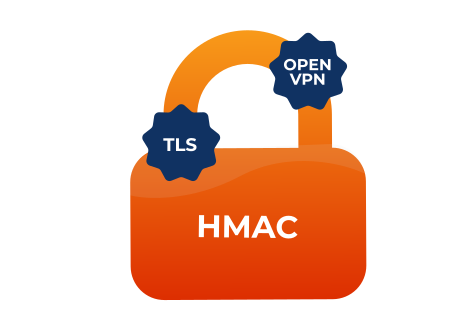
HMAC Verification
HMAC stands for Keyed-Hash Message Authentication Code. This code prevents hackers from making amendments to the data while streaming. OpenVPN and TLS rely on hashes for data authentication.